|
| This Week... |
|
Final stages of Freedesktop.org naming compliance performed on the Oxygen mimetype icons. IMAP-related crashes targeted in KMail. Many KFilePlugins ported to use Strigi. Better zoom and preview size interaction in Digikam. Optimisations in KSysGuard. Better integration with NEPOMUK-KDE interface elements in Dolphin, NEPOMUK-KDE components move to the kdereview module. Further Kst documentation work. Continued interface experiments and code progress towards Amarok 2.0. "Flame" window destruction effect in the KWin Composite branch. KBackup is renamed "Galmuri" due to naming conflicts.
|
Sebastian Trueg discusses the plans for K3b post-1.0, and his wider plans concerning NEPOMUK and KDE:
|
Now that K3b 1.0 has finally been released the development will surely not stop. K3b 1.0.1, the mandatory bugfix release is already in the pipeline. All those release candidates did not help in fixing all the bugs because, let's face it, they were mostly tested by geeks like myself and we are not the best when it comes to finding bugs ;).
I already have plans for 1.1 and big plans for 2.0 which will be the first KDE 4 release of K3b. For K3b 1.1, I plan to merge CD and DVD projects with the introduction of Blu-ray support. Having yet another project type is just confusing. Thus, I will not make a distinction between CD, DVD, or Blu-ray anymore. There will only be one copy dialog and only one data project. For K3b 2.0 I plan a big refactoring of libk3b which will result in a very modular API consisting of image creators and image writers. An image creator will then be connected to a writer in a generic manner. Also, K3b 2.0 will introduce the K3b image format which means that images created via K3b will contain all the necessary information to write them back to media later on.
Besides K3b, I have big hopes for NEPOMUK-KDE or, better, KMetaData. I just moved it to the kdereview module to give people the possibility to have a look at it and test it. I think there is still big confusion about what it is good for.
So far, KMetaData provides a nice API for creating metadata for all kinds of information, for example files. The SVN version of Dolphin already contains file rating, tagging, and commenting features using KMetaData. The code to achieve this is quite simple.
I present this example often but I think it is worth mentioning it again:
// create a new File instance KMetaData::File f( "/tmp/trueg/testfile" );
// make sure the path (called location here) is set properly f.setLocation( "/tmp/trueg/testfile" );
// now set some metadata f.setRating( 5 ); f.setComment( "I am a comment" );
Looks very simple and it is. The nice thing is that the File class has been auto-generated from an ontology. The ontology defines which resource types have which properties. They also contain information like localised labels and comments for properties. The latter could be used to create a metadata GUI in a generic manner. An API for this (the localised labels) does not exist yet but is planned. The idea is to categorize metadata via these ontologies.
To give you a bigger example of what KMetaData is intended for: I recently talked to Christian Muehlhaeuser from Amarok and he was very interested in the replacement of the Amarok collection with the KMetaData store. The benefits would be:- Strigi would take care of gathering all the metadata from the files like the artist or the title.
- Amarok would have access to this information without "building the collection".
- The rating and the tagging in Amarok would be reusable in all other applications, for example desktop search.
- Within Amarok more advanced information could be stored and in the future nice features could emerge:
- Amarok could not only use the last.fm hints for recommendations, but also stuff like "which other tracks were often in the same playlist as the current one".
For this to be doable we need to extend the KMetaData API with nice query functionalities. ATM it is possible to perform full SPARQL queries on the RDF repository which we store the metadata in but it would be nice to have a simpler API for the day-to-day work. I would really appreciate input on this.
Well, the NEPOMUK-KDE project has been around for some months now but I still have problems to get proper exposure for it. If you are interested in it please don't hesitate to contact me with questions of all kind.
|
|
Paolo Capriotti expands on his recent announcement of a KBattleShip rewrite for KDE 4:
|
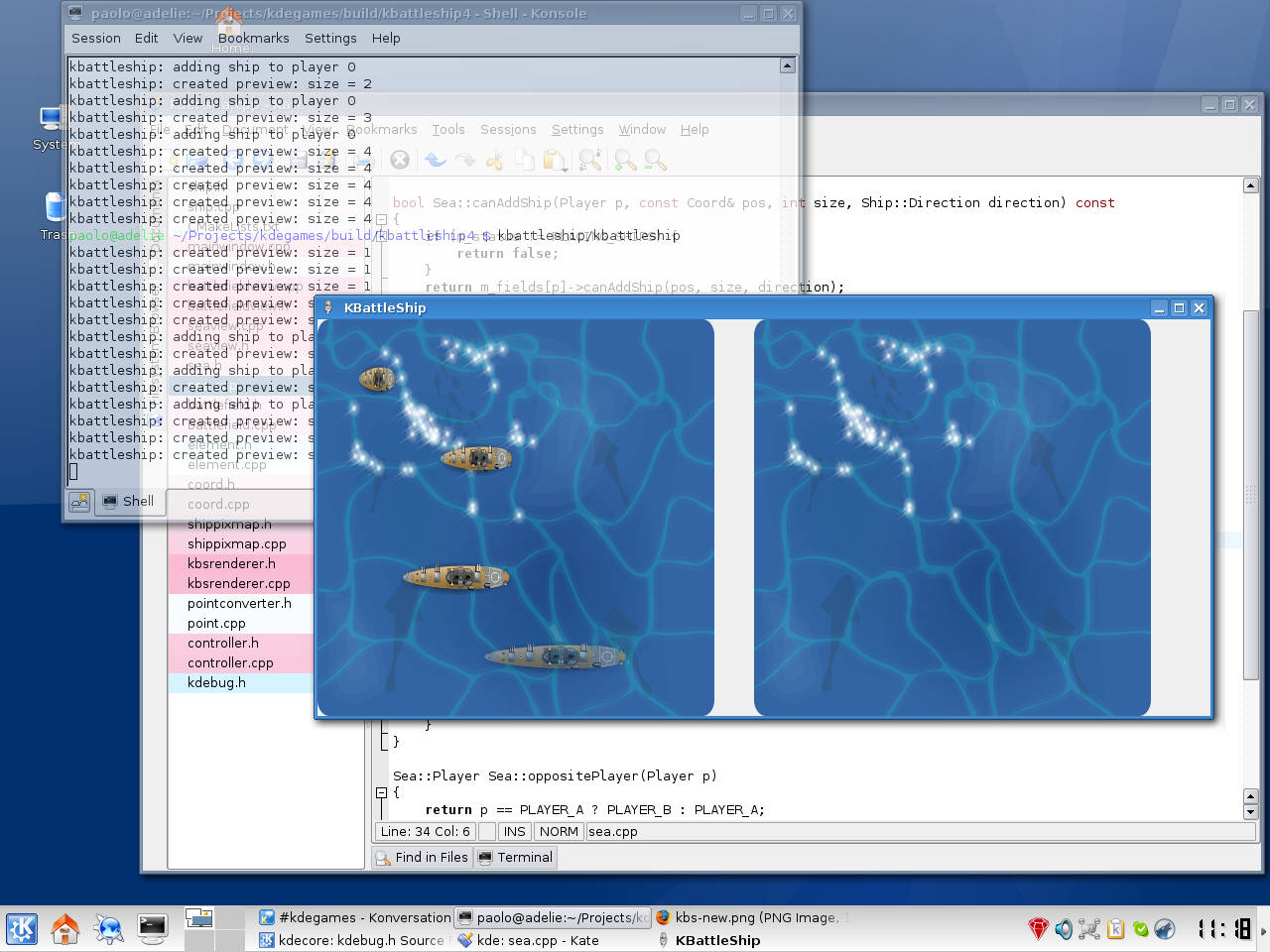
This week I have been working on a complete rewrite of KBattleShip for KDE 4. Since the combined efforts of Riccardo Iaconelli and myself to work on the existing code had not been as fruitful as initially hoped, we finally decided that the easiest and cleanest solution would be to start from scratch, and so I did.
The old code was very difficult to understand and update, because the functionality was spread across multiple classes with responsibilities which were not cleanly separated, and encapsulation was very poor. The logic of the game was repeated in many places, and there was no clear separation between the logic and the interface. Plus, the lines of code amounted to over 6000, which for such a simple game is a bit much. All of these problems made working on that code a real pain, hence our radical decision.
The main objectives of the rewrite are (as with the other KDE games): porting the graphics to SVG and making the windows scalable. At the moment I have a half-working scalable main window and I can already play against a dumb AI.
If all goes well, we could have a pretty playable game by the next weekend, and I could start thinking about multiplayer mode and GGZ integration.
The new KBattleShip will use KGameCanvas for drawing. KGameCanvas is a minimalistic and easy to use canvas framework written by Maurizio Monge which originates from our common work on KBoard - KBoard is a generic board game application, which I hope to shape into a beta release in a couple of weeks. There are already a few games in the KDE Games module which use it as a substitute for QGV, with a noticeable improvement in terms of performance (QGV is optimized for handling thousands or millions of sprites, while games usually only need less than a hundred).
|
|
This week saw the migration of Oxygen mimetype icon names to the Freedesktop.org Icon Naming Specification, with the attendant code adjustments in applications to use the new icon names. This completes the renaming work of recent weeks, with the default KDE iconset of KDE 4 now largely cross-desktop compliant. Now for the other iconsets...
|
|
| Statistics |
|
| Contents |
|
|
Bug Fixes |
Features |
Optimise |
Security |
Other |
|
Accessibility |
|
|
|
|
|
|
Development Tools |
|
|
|
|
|
|
Educational |
|
|
|
|
|
|
Graphics |
|
|
|
|
|
|
KDE-Base |
|
|
|
|
|
|
KDE-PIM |
|
|
|
|
|
|
Office |
|
|
|
|
|
|
Konqueror |
|
|
|
|
|
|
Multimedia |
|
|
|
|
|
|
Networking Tools |
|
|
|
|
|
|
User Interface |
|
|
|
|
|
|
Utilities |
|
|
|
|
|
|
Games |
|
|
|
|
|
|
Other |
|
|
|
|
|
|
|
Bug Fixes |
|
Development Tools |
|
Oliver Kellogg committed changes in /branches/KDE/3.5/kdesdk/umbrello:
|
|
CodeGenerationPolicyPage constructor 3rd arg should have been CodeGenPolicyExt*, this fixes the bug that the code generation option settings were not becoming effective, and also fixes a crash related to the codegen settings dialog. |
|
|
|
|
|
|
Oliver Kellogg committed changes in /branches/KDE/3.5/kdesdk/umbrello/umbrello:
|
It looks as though the bug fixed by commit 644749 may have been causing the problems with the advanced code generators, too.
I'm experimentally lifting the BUG84739 barrier.
If you feel adventurous and want to help improving Umbrello then go to the Setting->Configure Umbrello menu and enable "Use new C++/Java/Ruby generators".
Is the advanced-codegen configuration back to stable? Please send reports here. |
|
|
|
|
|
|
Paulo Moura Guedes committed changes in /trunk/KDE/kdewebdev/klinkstatus/src:
|
- initialize TidyInfo in all constructors, which prevents a crash. - forgot there is a keyPressEvent so remove the returnPressed connection
There is strange things in KHistoryCombo:
1. The first item inserted, at startup, shows no text, in the popup 2. At the first enter on a completion dropdown item, it erases the current text. The second enter sets the text. |
|
|
|
|
|
|
Games |
|
Rolf Eike Beer committed changes in /trunk/KDE/kdegames/katomic:
|
Fix molecule weight
Atoms can be used multiple times. Now we add the atoms weight every time it is referenced in the mole_%i lines. We now have correct results for Caffeine. |
|
|
|
|
|
|
|