 KDE Commit-Digest
This week has seen a several interesting turns in the code base, not least of which is the move to Qt 4.4. This brings a number of important improvements for KDE 4.1, and for Plasma in particular: WebKit which allows us to display web content on the Plasma canvas, Widgets-on-Canvas, or WoC, which allows us to freely mix traditional widgets with canvas content and many improvements in QGraphicsView that will allow us to do things like the applet handles much better. Over the next few months the Plasma team will be working on taking full advantage of these new features as well as implementing plasmoids that start to shape the Plasma workspace as we've envisioned it.
In April, several of us will be coming together in Milano, Italy, for a four day Plasma developer sprint codenamed "Tokamak" (continuing the tradition of bad high energy physics puns in the project ;).
We've also gotten the necessary permission from the translation teams to backport some of the more requested features from 4.1 into the 4.0 branch, so a number of features that impact the panel and other parts of the Plasma workspace have made their way into svn for 4.0.2. Over 80 commits have been backported thus far, and we'll be doing another batch of backports for 4.0.3 next month.
Plasma itself has continued to be refined with numerous bugs being squashed and configuration for things such as SVG Plasma themes appearing in the user interface. Speaking of SVG themes, the theme system now adapts automatically to non-composited environments as well as low color displays. This is driven in part by people starting to use Plasma in both thin client as well as mobile device systems.
Not to be left out, KRunner is also being improved. A number of performance improvements were checked in this week, and work is underway to improve the user experience including better ranking of matches, the ability for users to discover the syntax offered by the various runners (e.g. "spell <word>" checks spelling via Sonnet, but who knows that?) and an improved interface display.
As an interesting aside, with just two lines of code (one using Solid and the other Threadweaver), the number of threads used by krunner to perform matches with now scales along with the number of CPU cores available on the machine (with the abiity to set a hard upper limit on it via the configuration). This shows just how powerful and useful the new frameworks in KDE4 are.
Issue 97
10th February 2008 by Danny AllenThis Week...
Plasma applets can now be dragged from the desktop to the panel. More internet data sources for the Picture Frame and Comic Plasmoids. Configuration dialogs are added to many Plasmoids. The in-development "WorldClock" Plasmoid supercedes the KWorldClock standalone application. A new Plasma applet: Conway's Game of Life. KRunner becomes completely plugin-based. Support for editing GPS track lists in Digikam. More work on expanding theming capabilities across KDE games. A variety of enhancements in KOrganizer. Initial work on a web interface to control downloads in KGet. Work on paths and snap guides in Karbon. A HTML part plugin in the scripting application creator, Kommander. Mono (C#) KDE bindings reach a usable state. Python support in KDevelop4. A return to development work on Decibel. KMail gets a new maintainer, with already-noticeable improvements. KBluetooth and KRecipes begin to be ported to KDE 4. The game Kollision moves from playground/games to kdereview. A new game, KDiamond, is imported into KDE SVN.
Aaron Seigo talks about recent developments in Plasma:
Put three physics students in a room, wait some days, and you get: a new game for KDE. Basically, this is how KDiamond began. These three students are Felix Lemke, Jeffrey Kelling, and me. As I'm the only one who's familiar with Qt and kdelibs, I had to do the main job while Jeffrey assisted with advice. Felix does not have any C++ experience (but has promised to learn it in the next months), so he helped out with an initial graphics theme which is now the "classic theme" for KDiamond. It was really basic, but was more than enough to test my rendering engine.
Except for Jeffrey, we are relatively new to Linux. We've all chosen KDE because it was already widely spread in our environment and while programming with Qt and kdelibs, I saw yet again that it was the right decision. Some years ago (in the Windows era of my life), I've worked with some Microsoft libraries. Compared to kdelibs, what I got there was quite uncomfortable and data-centric while the design of kdelibs is more based on what a developer actually needs. If you have some basic C++ skills, I really recommend you to try kdelibs for your next program.
KDiamond is a Bejeweled clone or, more generically, a three-in-a-row game.
KDiamond is available from KDE SVN in playground/games since last Friday, and has evolved quickly: Like most other games in KDE, it is now based on QGraphicsView, and includes some basic animations. It was imported to KDE SVN after its first release (with many help from the friendly guys at the #kdegames channel). What you're seeing here is not the mentioned classic theme, but the new default theme created by Eugene Trounev:
To make the list of contributors complete, many thanks to Dmitry Suzdalev, Albert Astals Cid, Riccardo Iaconelli, and Pino Toscano for their help on improving the code. Also, as I learned to develop with kdelibs by reading code from others, I think this is the right place to thank the developers of Klipper, KLines, KMines, and KNetwalk for your clean and readable code. Now the contributors' list is really complete!
If you always have wanted to play a Bejeweled game on your KDE desktop, this is your chance to contribute: the gameplay of KDiamond needs balancing, so tell me about your impressions of the difficulty of the different levels: Was the game too easy or too hard, and what about the difficulty levels? (Bug reports are also welcome!).
Send your reports to my email address, which you can find in KDiamond's about dialog.
Except for Jeffrey, we are relatively new to Linux. We've all chosen KDE because it was already widely spread in our environment and while programming with Qt and kdelibs, I saw yet again that it was the right decision. Some years ago (in the Windows era of my life), I've worked with some Microsoft libraries. Compared to kdelibs, what I got there was quite uncomfortable and data-centric while the design of kdelibs is more based on what a developer actually needs. If you have some basic C++ skills, I really recommend you to try kdelibs for your next program.
KDiamond is a Bejeweled clone or, more generically, a three-in-a-row game.
KDiamond is available from KDE SVN in playground/games since last Friday, and has evolved quickly: Like most other games in KDE, it is now based on QGraphicsView, and includes some basic animations. It was imported to KDE SVN after its first release (with many help from the friendly guys at the #kdegames channel). What you're seeing here is not the mentioned classic theme, but the new default theme created by Eugene Trounev:
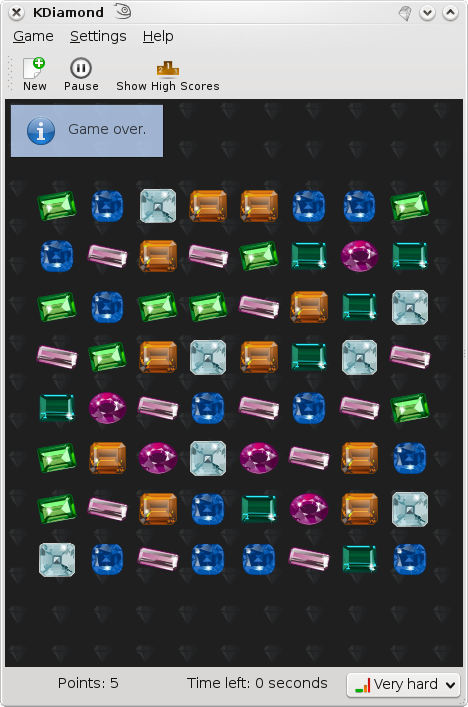 |
To make the list of contributors complete, many thanks to Dmitry Suzdalev, Albert Astals Cid, Riccardo Iaconelli, and Pino Toscano for their help on improving the code. Also, as I learned to develop with kdelibs by reading code from others, I think this is the right place to thank the developers of Klipper, KLines, KMines, and KNetwalk for your clean and readable code. Now the contributors' list is really complete!
If you always have wanted to play a Bejeweled game on your KDE desktop, this is your chance to contribute: the gameplay of KDiamond needs balancing, so tell me about your impressions of the difficulty of the different levels: Was the game too easy or too hard, and what about the difficulty levels? (Bug reports are also welcome!).
Send your reports to my email address, which you can find in KDiamond's about dialog.
I would like to turn the "introduction" features (like the one above) into a regular series on the Digest - I know there are new developers and projects all the time (new KDE SVN accounts are also handled through SVN... you can't hide from me!) - Stefan emailed me after my request last week, and you can too!
I look forward to reading (and then publishing!) your introductions - send them to me!
I look forward to reading (and then publishing!) your introductions - send them to me!
Statistics
| Commits | 2830 by 245 developers, 6750 lines modified, 1558 new files |
| Open Bugs | 15952 |
| Open Wishes | 13629 |
| Bugs Opened | 355 in the last 7 days |
| Bugs Closed | 239 in the last 7 days |
Commit Summary
| Module | Commits |
| /trunk/KDE |
731
|
| /trunk/l10n-kde4 |
595
|
| /branches/stable |
270
|
| /trunk/extragear |
238
|
| /trunk/playground |
222
|
| /branches/KDE |
159
|
| /trunk/www |
121
|
| /trunk/kdesupport |
108
|
| /trunk/koffice |
98
|
| /branches/extragear |
71
|
| Lines | Developer | Commits |
|
267
|
Gilles Caulier |
114
|
|
343
|
Volker Krause |
83
|
|
178
|
Laurent Montel |
81
|
|
71
|
Chusslove Illich |
71
|
|
66
|
Thanomsub Noppaburana |
60
|
|
144
|
Aaron J. Seigo |
58
|
|
187
|
Albert Astals Cid |
58
|
|
131
|
Allen Winter |
53
|
|
108
|
David Faure |
48
|
|
62
|
Patrick Spendrin |
48
|
Internationalization (i18n) Status
| Language | Percentage Complete |
| Portuguese (pt) |
98%
|
| Greek (el) |
97%
|
| Swedish (sv) |
96%
|
| Japanese (ja) |
93%
|
| German (de) |
87%
|
| Estonian (et) |
87%
|
| Spanish (es) |
86%
|
| Polish (pl) |
86%
|
| French (fr) |
86%
|
| Dutch (nl) |
85%
|
Bug Killers and Buzz
| Person | Bugs Closed |
| Matt Rogers |
58
|
| Thomas McGuire |
24
|
| Pino Toscano |
17
|
| Luboš Luňák |
13
|
| Leonardo Finetti |
10
|
| Peter Penz |
8
|
| Tommi Tervo |
8
|
| Riccardo Iaconelli |
6
|
| Gilles Caulier |
6
|
| Joris Guisson |
6
|
| Program | Buzz |
| Amarok |
13060
|
| KMail |
4585
|
| K3B |
4115
|
| Kopete |
3582
|
| Solid |
3180
|
| Plasma |
3149
|
| KDevelop |
2945
|
| Kate |
2776
|
| Phonon |
2536
|
| Marble |
1932
|
| Person | Buzz |
| Tobias Hunger |
4070
|
| Aaron J. Seigo |
2828
|
| David Faure |
2495
|
| Stephan Kulow |
1786
|
| Torsten Rahn |
1232
|
| Laurent Montel |
1089
|
| Jonathan Riddell |
1059
|
| Adriaan de Groot |
812
|
| Stephan Binner |
804
|
| Thiago Macieira |
700
|
Commit Countries
Commit Demographics
Sex
Age
Contents
| Bug Fixes | Features | Optimization | Security | Other | |
|---|---|---|---|---|---|
Accessibility | |||||
Development Tools | [] | [] | |||
Educational | [] | [] | |||
Graphics | [] | [] | [] | ||
KDE Base | [] | [] | [] | [] | |
KDE-PIM | [] | [] | |||
Office | [] | [] | |||
Konqueror | |||||
Multimedia | [] | [] | [] | ||
Networking Tools | [] | [] | |||
User Interface | [] | [] | [] | ||
Utilities | [] | [] | |||
Games | [] | [] | [] | ||
Other | [] |
There are 137 selections this week
Bug Fixes
Educational
Inge Wallin committed changes in /trunk/KDE/kdeedu/marble:
Hopefully fix the crash in goHome in the qt only version. Unfortunately untested on the qt-only version, where there used to be a crash.
There is a hurry because tackat need this for his train ride and I don't have time to build a qt only version before the train leaves.
Diffs: 1, 2, 3 Revision 770609
Inge Wallin committed changes in /trunk/KDE/kdeedu/marble:
Carsten Niehaus committed changes in /trunk/KDE/kdeedu/kalzium/src:
Inge Wallin committed changes in /trunk/KDE/kdeedu/marble:
Fix all zoom issues.
The split of MarbleWidget into MarbleWidget and MarbleMap is now DONE!
Step 3 is fixing some issues in the API.
Diffs: 1, 2, 3 Revision 772858
Graphics
Tobias Koenig committed changes in /trunk/KDE/kdegraphics/okular:
Update the bookmark menu whenever bookmarks have been renamed in the sidebar
KDE Base
Riccardo Iaconelli committed changes in /trunk/KDE/kdebase/workspace/plasma/containments/desktop/renderthread.cpp:
Set the size to 1 instead of asserting and crashing.
Aaron, as this is controversial, I'll let you decide if this fix is ok. (read the bugreport to know more)
Jos van den Oever committed changes in /trunk/kdesupport/strigi/src/dummyindexer:
Fix a huge bug in deepgrep. deepgrep has been broken since version 0.5.2. In this version, deepgrep used an IndexManager that provides the IndexWriter, instead of using the GrepIndexWriter directly.
The manager returned a dummy writer instead of the required GrepIndexWriter.
Now the right IndexWriter is returned.
Diffs: 1, 2, 3 Revision 770493
Aaron J. Seigo committed changes in /trunk/KDE/kdebase/workspace/libs/plasma/widgets/tooltip.cpp:
while getting the size wrong is bad, flickering like crazy is even worse =)
resize after the contents have been set to get a rational size out of the widget.
Diffs: 1 Revision 770966
Sebastian Pipping committed changes in /trunk/KDE/kdelibs/kate/syntax/data/yaml.xml:
Add fixed version of Yaml highlighter
User Interface
C. Boemann committed changes in /trunk/KDE/kdebase/runtime/kstyles/oxygen:
Apply patch by David Benjamin fixing LTR layout of QToolBox he gave me two options and i chose the one that mirrored the sloping divider.
It also fixes icons from appearing twice in QToolBox
Thanks David
Games
Pierre Ducroquet committed changes in /trunk/KDE/kdegames/konquest:
Additional fix for bug 157531.
Remove the top bar resizing issue : now, instead of having a disappearing line edit (and a lot of resizes because of this), we use setEnabled(true/false) on the line edit.
It means much improved performances, no more bad looking resizes/repaints... Only good things.
Features
Development Tools
Andras Mantia committed changes in /trunk/playground/devtools/kommander-plugins/htmlpart:
Andreas Pakulat committed changes in /trunk/playground/devtools/kdevelop4-extra-plugins/python:
Eric Laffoon committed changes in /trunk/playground/devtools/kommander-plugins/timewidget:
Educational
Inge Wallin committed changes in /trunk/KDE/kdeedu/marble:
Frederik Gladhorn committed changes in /trunk/KDE/kdeedu:
Change the way grades are handled fundamentally.
Too bad, I didn't have the idea long ago.
Much simpler:
* One grade for each word, no longer the fromTranslation.
So whenever the user gets abc right, abc gets it's grade increased.
* Translation inherits from the new Text class.
* The new class KEduVocText will be used instead of QString in many places to for ex allow grades for individual conjugation forms etc.
* Add initial unittests for translation class.
Niels Slot committed changes in /trunk/KDE/kdeedu/kturtle/src/interpreter:
Frederik Gladhorn committed changes in /trunk/KDE/kdeedu/parley/plasmoid:
Maurizio Paolini committed changes in /trunk/KDE/kdeedu/kig:
Added support for cubic-line intersection in case two of the three intersection points are already present.
Author: Francesca Gatti
Diffs: 1, 2, 3, 4 Revision 772387
Graphics
Jesper Pedersen committed changes in /trunk/extragear/graphics/kphotoalbum:
Aurélien Gâteau committed changes in /trunk/KDE/kdegraphics/gwenview:
Gilles Caulier committed changes in /trunk/extragear/libs/kipi-plugins/gpssync:
Gilles Caulier committed changes in /trunk/extragear/libs/kipi-plugins/gpssync:
kipi-plugins from trunk (KDE4): digiKam has a new tool to edit a GPS track list using googlemaps!
More than one point can be edited over the ma at the same time...
A fresh screenshot of the tool in action is available here: <a href="/issues/2008-02-10/files/gpstracklisteditor.png">http://digikam3rdparty.free.fr/Screenshots/gpstracklisteditor.png</a>;
KDE Base
Chani Armitage committed changes in /trunk/KDE/kdebase/workspace/libs/plasma:
enable dragging from desktop to panel
note: there's no visual feedback before you release the mouse button, and there's no way to drag back to the desktop.
Diffs: 1, 2, 3, 4 Revision 770333
Anne-Marie Mahfouf committed changes in /trunk/playground/base/plasma/engines/potd/PoTD-list.txt:
add RSS feed for Wikimedia Commons Featured Pics
Diffs: 1 Revision 770347
Rob Buis committed changes in /trunk/KDE/kdelibs/khtml:
Marco Martin committed changes in /trunk/extragear/plasma:
this is a quite massive change to the comic applet, yeah i know quite hard to review sorry for that.
the main changes are:
- i've added a provider to <a href="http://www.osnews.com/comic">http://www.osnews.com/comic</a>; (got permission from them) it uses a rss feed so only last 15 will be available but i think is enough
- now the applet can be resized (option that can be disabled if you want to see the comic as is)
- the dataengine now gives more data that can also be cached at the moment it has only the url of the comic of the day, but i plan to use it also to pass the date of the previous and the next comic (useful for comics that don't have a strip every day)
- the url of the comic is displayed at the bottom of the applet and clicking on it it opens a web browser on that page (useful if the comic is scaled down and some (osnews) explicitly asks it)

Rafael Fernández López committed changes in /trunk/playground/libs/goya/goya:
Improve goya for letting line edits blink when they have the focus.
Improve line edits to see if we can make them being editable
Diffs: 1, 2, 3 Revision 770443
Rafael Fernández López committed changes in /trunk/playground/libs/goya/goya:
More real line edits, the cursor indicator moves with right and left arrows
Diffs: 1, 2 Revision 770554
Petri Damstén committed changes in /trunk/KDE/kdebase/workspace/libs/plasma:
Matthias Kretz committed changes in /trunk/KDE/kdelibs/kdeui:
add KFadeWidgetEffect as discussed on core-devel
Animates changes fading the new UI over the old look.
Diffs: 1, 2, 3, 4 Revision 770670
Matthias Kretz committed changes in /trunk/KDE/kdelibs/phonon:
add new helpers to handle the backend interfaces.
The idea is that when a backend interface needs a new virtual function the old interface is renamed but the Q_DECLARE_INTERFACE is kept (with the changed interface name).
That way implementations from backends compiled against older libphonon can still be casted to that renamed interface. A new interface is added with the name the old interface had before and a new Q_DECLARE_INTERFACE statement is added. That way backends automatically get source incompatible (kind of) which helps to find the places where new implementations are needed.
To make it easier on the frontend side to access the backend I added template magic structs/functions that will return either 0 or the correctly casted pointer.
Now I'm praying that all compilers we need to support can handle this code.
Diffs: 1, 2 Revision 770909
Dan Meltzer committed changes in /trunk/KDE/kdebase/workspace/plasma/containments/panel/panel.cpp:
Add support for using a borderless svg in the panel by adding a hint-no-border-padding element to the svg
Diffs: 1 Revision 771379
Ivan Čukić committed changes in /trunk/extragear/plasma/applets/lancelot/app/src:
Aaron J. Seigo committed changes in /trunk/KDE/kdebase/workspace/libs/plasma:
make Theme react to compositing changes
Diffs: 1, 2 Revision 771968
Henry de Valence committed changes in /trunk/playground/base/plasma/applets/cia.vc:
Configuration dialog for CIA.vc applet
Diffs: 1, 2 Revision 771989
Thierry Bastian committed changes in /trunk/kdereview/phonon/ds9:
Ivan Čukić committed changes in /trunk/playground/base/plasma/applets/script:
Simple spacer to be used on a panel for separating groups of applets.
Diffs: 1, 2, 3, 4 Revision 772055
Marco Martin committed changes in /trunk/KDE/kdebase/workspace:


Davide Bettio committed changes in /trunk/playground/base/plasma/applets/life:
Added configuration support.
Diffs: 1, 2, 3, 4 Revision 772366
Anne-Marie Mahfouf committed changes in /trunk/playground/base/plasma/engines/potd:
KDE-PIM
Thomas McGuire committed changes in /trunk/KDE/kdepimlibs/mailtransport:
Tobias Hunger committed changes in /trunk/playground/pim/decibel:
Extend the interface used for account storage integration:
* Add openStorage/closeStorage method.
* Add signal to show whether the storage is available.
Use this functionality in the account manager.
* Add an dataReset signal to the accountmanager to efficiently make a disappearing storage visible in the GUI.
Update accountmodel (in addons/kcm_accountmanager) to evaluate the new dataReset signal.
Frank Osterfeld committed changes in /trunk/KDE/kdepim:
Bruno Virlet committed changes in /trunk/KDE/kdepim/akonadi:
Andreas Hartmetz committed changes in /branches/kdepim/enterprise/kdepim/kmail:
Allen Winter committed changes in /trunk/KDE/kdepim/kmail/kmfoldercachedimap.cpp:
Ingo's patch to make cached imap local subscription work for top-level folders.
"while checking whether GMail can be used as lightweight groupware server. I noticed that local subscription only works for non-top-level folders, i.e. all top-level folders were shown unconditionally and KMail started to sync my kde-commits folder (very bad idea!).
The reason for this problem is that setHonorLocalSubscription( true ) is only called for the ListJobs of subfolders, but not when listing the top-level folders in the namespaces."
Diffs: 1 Revision 771724
Volker Krause committed changes in /trunk/KDE/kdepim/akonadi:
Add XSL script to convert a KConfigXT file into a D-Bus interface description. This can be used to make application settings available (and changeable) over D-Bus.
It's mostly a proof of concept for now to see if it helps us with configuring Akonadi resource agents with external applications.
Thomas Thrainer committed changes in /trunk/KDE/kdepim/korganizer:
o Use of Qt style sheets to define appearance of month view cells
o Month have now alternating colors (computed automatically from the colors defined in the configuration). This makes it easier to see what's going on while scrolling.
o The month view is now scrollable. Four buttons are provided to go back and forward one week or one month. The mouse wheel works too. Going back and forward one month using PgUp and PgDown works too.
o Added an option in the configuration to turn on/off the display of icons in the month view (can save some space, if the icon is not so important).
o Some optimizations, mainly related to scrolling the month view.
- removed the hash mDateToCell. It is about 3 times faster to compute the index in the mCells array using the start date and the date we want to get cell from. getCell() does this now.
o ToDo's with only a due date (but no due-time) were not displayed (because KDateTime is invalid in such a case, altough KDateTime::date() returns a valid date). This is fixed now.
o When clicking on the background of a month view cell, the cell was not selected. This is fixed now.
Office
Cyrille Berger Skott committed changes in /trunk/koffice/filters/krita:
Dag Andersen committed changes in /trunk/koffice/kplato:


Jan Hambrecht committed changes in /trunk/koffice/libs/flake:
Jan Hambrecht committed changes in /trunk/koffice/libs/flake:
Rob Buis committed changes in /trunk/koffice/karbon/plugins/simpletextshape:
Implement undo/redo of add/remove text range.
Diffs: 1, 2, 3, 4 Revision 772082
Jan Hambrecht committed changes in /trunk/koffice/karbon:
Rob Buis committed changes in /trunk/koffice/karbon/plugins/simpletextshape:
Add a command for font style changes. There is still something wrong with updating the config widgets after undo/redo though.
Diffs: 1, 2 Revision 772621
Martin Pfeiffer committed changes in /trunk/koffice/libs/flake:
Jan Hambrecht committed changes in /trunk/koffice/libs/flake:
Multimedia
Nikolaj Hald Nielsen committed changes in /trunk/extragear/multimedia/amarok/src/servicebrowser/magnatunestore:
Dan Meltzer committed changes in /trunk/extragear/multimedia/amarok/src:
Networking Tools
Urs Wolfer committed changes in /trunk/KDE/kdenetwork/kget:
New feature for KGet: Webinterface.
The webinterface lets you control your downloads over network and KGet.
Based on QTcpServer. Browser part based on Ajax and JSON (with JavaScript framework MooTools).
This is just initial work; at the moment you are able to list your current downloads and add new ones.
Romain Castan committed changes in /branches/work/kopete/iup-isi-group:
Joris Guisson committed changes in /branches/ktorrent/newstuff:
Urs Wolfer committed changes in /trunk/KDE/kdenetwork/kget:
Add support to start, stop and remove transfers from webinterface.
Diffs: 1, 2, 3 Revision 772997
User Interface
Riccardo Iaconelli committed changes in /trunk/KDE/kdebase/runtime/pics/oxygen:


Utilities
Tom Patzig committed changes in /branches/work/~tpatzig/kbluetooth4/src:
Ralf Habacker committed changes in /trunk/kdesupport/kdewin-installer:
- implemented display of number of downloaded files and number of currently downloaded files for gui installer
Diffs: 1, 2, 3, 4 Revision 771346
Jonathan Riddell committed changes in /branches/KDE/3.5/kdeutils/kmilo/generic:
Patch from Matej Laitl
* kmilo generic plugin is now configurable (no gui yet, one have to use kwriteconfig) - one can set which kmix channels to mute and set volume on (separately - needed for Intel HDA soundcards) and one can now fine-tune "slow" and "fast" volume steps (bugs 149183, 92730)
* when channels are not configured, query kmix for master channel
* some cleanups (removal of dupe code) and new volume computation algo changed
a bit (see comments is patch)
* unregister global shortcuts in destructor (bug 75169)
* support for controlling an extra channel, for people with surround sound
* README extended to contain relevant information
Diffs: 1, 2, 3 Revision 771580
Friedrich W. H. Kossebau committed changes in /trunk/playground/utils/okteta/program/libkakao/controllers:
Games
Paolo Capriotti committed changes in /trunk/playground/games/kollision:
Implemented pause, as suggested by Albert.
Diffs: 1, 2, 3, 4 Revision 770526
Paolo Capriotti committed changes in /trunk/kdereview/kollision:


Stephan Kulow committed changes in /trunk/KDE/kdegames/kpat:
Julien Bringuier committed changes in /trunk/playground/games/kapman:
Dmitry Suzdalev committed changes in /trunk/KDE/kdegames/klines:
Introduce support for themeable border around the game field.
Idea belongs to (guess who) Eugene. He already adjusted current default theme to include border for me to play with while implementing this feature. Not sure if it's the final one :)
Ah, and older themes still will work - KLines will figure out whether theme has a border element and act accordingly.
Waiting for new themes to come up! ;)
Stefan Majewsky committed changes in /trunk/playground/games/kdiamond/src:
Lay foundations for KGamePopupItem: remove Greeter, block any input to Game after finishing.
There are also some smaller items:
* remove Debug headers
* fix time measurement in Game
* fix visibility of selection markers when resuming the Game after a pause
* fix behavior of selection markers in mouse events* make "Quit" action functional
Optimization
KDE Base
Aaron J. Seigo committed changes in /trunk/KDE/kdebase/workspace/libs/plasma/widgets:
* set the palette on theme changes only
* don't grab the data until actually shown
* show the right size and position when we are showing the tip
* allow the tooltip to figure out it's size with the help of the widget (it knows when to do this, the widget only knows how)
* don't show the tip on every item's mouse over, respect the small timeout
* only create a ToolTipData struct for those items that actually use it (memory savings as well as makes the check for showing the tip a lot simpler)
Diffs: 1, 2, 3, 4 Revision 771314
Jos van den Oever committed changes in /trunk/kdesupport/strigi/src:
Multimedia
Koos Vriezen committed changes in /trunk/extragear/multimedia/kmplayer/src:
replace cairo_push_group by own backing store, improves large area update dramatically (though doesn't help with tearing effect, which I was trying to attack)
Diffs: 1, 2 Revision 770549
Other
Development Tools
Arno Rehn committed changes in /branches/work/kdebindings-smoke2:
* Regenerated KDE classes from the 4.0 headers
* Added kimono runtime
* Only added classes from core, gui and sonnet. KIO classes won't compile at the moment due to a bug in gmcs. As the other modules like DOM and KParts have dependencies on KIO they can't be included, too.
Maybe the gmcs crash can somehow be avoided.
* Added Kimono example app. Install Qyoto & Kimono and compile it with
gmcs -r:qt-dotnet,kde-dotnet test.cs
* When looking up a type by it's name in the Qyoto runtime, scan through all referenced and used assemblies.
* Don't try to call virtual methods and don't do anything in qyoto_event_notify if the application has already terminated. Fixes some segfaults on application quit.
* Install all qyoto headers.
* Use partial classes all over the place and nested classes instead of namespaces when generating the C# sources.
Arno Rehn committed changes in /branches/work/kdebindings-smoke2/csharp/kimono:
Andreas Pakulat committed changes in /trunk/playground/devtools/kdevelop4-extra-plugins/python/DESIGN:
Add a start of a design document
Diffs: 1 Revision 772968
Graphics
Albert Astals Cid committed changes in /trunk/KDE/kdegraphics/okular/generators/chm:
Andrew Walker committed changes in /branches/extragear/kde3/graphics/doc/kst:
continue with javaScript documentation
Diffs: 1, 2 Revision 772544
KDE Base
Allan Sandfeld Jensen committed changes in /trunk/KDE/kdelibs/khtml/html/dtd.cpp:
Allow more violations of HTML 4 because these violations are required for the Acid 3 test.
Diffs: 1 Revision 770284
Marco Martin committed changes in /trunk/KDE/kdebase/workspace:
Sets on Applet::constraintsUpdated() the maximum content width for horizontal panels and the maximum content height for vertical panels as IconSize(KIconLoader::Panel) this makes vertical larger panels actually usable.
Some notes:
- it works only for applets that aren't forced to square
- in horizontal panels only for applets that don't have expandingDirections()=Qt::Horizontal
- in vertical panels only for applets that don't have expandingDirections()=Qt::Vertical
On other news the kickoff applets are modified to use this new feature
Henry de Valence committed changes in /trunk/playground/base/plasma/applets/worldclock:
Sebastian Kügler committed changes in /trunk/KDE/kdebase/workspace/plasma:
Make Plasma's pager applet use kcolorscheme and the font from the taskbar. Also make Plasma's colorscheme use colors from the Oxygen palette.
With this patch, the pager should be nicely themable.
Review: <a href="http://matt.rogers.name/r/51">http://matt.rogers.name/r/51</a>;
Diffs: 1, 2 Revision 770660
Matthias Kretz committed changes in /trunk/KDE/kdelibs/phonon:
This code is _very_ old (it's a leftover from the first KDEMM prototype for KDE3) and I can't find a reason why it's still needed.
To the contrary I think it made VideoPlayer behave different than described in the docs. (I.e. it would start playing even if you called only load())
Diffs: 1, 2 Revision 770700
Thierry Bastian committed changes in /trunk/kdereview/phonon/ds9:
Aaron J. Seigo committed changes in /trunk/KDE/kdebase/workspace/libs/plasma/containment.cpp:
Injects the containment's context menu into the widget's. This allows, e.g. "Configure Panel" to show up in the context menu.
Diffs: 1 Revision 771315
Aaron J. Seigo committed changes in /trunk/KDE/kdebase/workspace/plasma/tools/plasmoidviewer/main.cpp:
i think mice should die. what can i say, it's the cat in me.
Diffs: 1 Revision 771357
Aaron J. Seigo committed changes in /trunk/playground/base/plasma/applets/svgpaneltest:
* add ContentAtOrigin for panel / dialogs; masively broken atm, will work on that next
* it's not an Svg::ImageSet
* don't hold on to so many value that are only ever used during
* various formatting issues
bottom line: it now works for the applet case and works nicely. have tested in plasma as well. next: panels and dialogs htne into libplasma and porting the code over to it
Diffs: 1, 2, 3 Revision 771453
Đức Hiếu Hoàng committed changes in /trunk/extragear/plasma/dataengines/comic/xkcdprovider.cpp:
Some comics are jpeg (the earliest ones, the Choice series, and #288), so extract the full filename. This hopes that xkcd won't ever change to jpeg or tiff.
Diffs: 1 Revision 771503
Aaron J. Seigo committed changes in /trunk/KDE/kdebase/workspace/libs/plasma/layouts:
tired of the "expect crashes" output all the time, i just fixed it properly by deleting the existing layout. since the layout makes itself the parent of the child layout and already deletes it in the dtor, this only makes sense. hello greater safety and goodbye scary console output ;)
Davide Bettio committed changes in /trunk/playground/base/plasma/applets:
Aaron J. Seigo committed changes in /trunk/KDE/kdebase/workspace/plasma/containments/panel:
use SvgPanel. massive code reduction and centralization of this code == goodness.
Diffs: 1, 2 Revision 771713
Martin Gräßlin committed changes in /trunk/KDE/kdebase/workspace/kwin/effects/flipswitch.cpp:
Disable animation if there is only one window.
Marco Martin committed changes in /trunk/extragear/plasma:
This patch adds two items to the dataengine: "Next identifier suffix" and "Previous identifier suffix" that says where to search the previous and next comics (if any) so now it's not tied to a date and to the concept of having one update a day.
and this fixes the xkcd comic (bug 153872) that uses integer identifiers instead of dates for the comic so now the logic to where search the next/previous is delegated to the comicprovider, and if there is no suffix the dataengine simply loads the today's comic.
the cache still works, but is disabled for today's comic, because it can become stale if it was actually an old comic and a new one is published today, and of course today it won't have a "Next identifier suffix" but tomorrow will.
Aaron J. Seigo committed changes in /trunk/KDE/kdebase/workspace/krunner:
Aaron J. Seigo committed changes in /trunk/KDE/kdebase/workspace/plasma/runners:
Tobias Koenig committed changes in /trunk/extragear/plasma:
Urs Wolfer committed changes in /trunk/KDE/kdelibs/kdeui/paged/kpageview.cpp:
Use fade effect for title widget in all paged dialogs.
Probably we could also use it for the whole page, but I'm not sure if there would be any performance problems for very big pages (e.g Konqueror config dialog) on slow systems.
Anyway, it would just need two more lines.
Diffs: 1 Revision 772510
Aaron J. Seigo committed changes in /trunk/KDE/kdebase/workspace/libs/plasma/abstractrunner.cpp:
automatic rate limiting of runners: mark ill performing runners as slow, but let speed runners marked as slow back into the main thread pool.
Diffs: 1 Revision 772741
Bill Egert committed changes in /trunk/KDE/kdebase/workspace/plasma/applets/tasks:
Change the tasks applet to use flowlayout. I think this provides a much cleaner panel.
Diffs: 1, 2, 3 Revision 773062
KDE-PIM
Ingo Klöcker committed changes in /trunk/KDE/kdepim/kmail/aboutdata.cpp:
Thomas McGuire took over maintainership of KMail.
Diffs: 1 Revision 770364
Jonathan Riddell committed changes in /trunk/KDE/kdepimlibs/kioslave/sieve:
Allen Winter committed changes in /trunk/KDE/kdepim/kmail/messageactions.cpp:
Rename "Create Task" to "Create To-do".
In kdepim we use "to-do'.
I see other "Task" strings in KMail, mostly referring to groupware folder types. Not sure if I'm allowed to change those.
But I'd like to if permitted.
Diffs: 1 Revision 772015
Thomas McGuire committed changes in /trunk/KDE/kdepim/kmail:
Remove per-account identities for pop, maildir and local accounts.
It made no sense at all, as a maildir folder can not be associated with an account (and kmfolder*imap is the only subclass of FolderStorage which actually reimplements account()).
Diffs: 1, 2 Revision 772525
Kevin Krammer committed changes in /trunk:
Moving Akonadi->KResource bridges to kdepim
Diffs: 1, 2 Revision 772775
Tom Albers committed changes in /trunk/playground/pim/mailody:
Tom Albers committed changes in /trunk/playground/pim/mailody:
Office
Dirk Mueller committed changes in /tags/koffice/1.9.95.2:
Tag KOffice 1.9.95.2
Diffs: 1 Revision 770890
Ariya Hidayat committed changes in /trunk/koffice:
Jan Hambrecht committed changes in /trunk/koffice/libs/flake:
Multimedia
Harald Sitter committed changes in /trunk/extragear/multimedia/amarok/src/images/icons:


Nikolaj Hald Nielsen committed changes in /trunk/extragear/multimedia/amarok/src/servicebrowser/opmldirectory/OpmlDirectoryService.cpp:
For now, as we are using a hard coded opml podcast url, use the noadult version as the adult podcasts feature very prominently at the top of the podcast list otherwise.
The plan is to make this service configurable so people can add whatever directory they wish, so this is just what we considder a more sensible default for now...
Diffs: 1 Revision 771232
Nikolaj Hald Nielsen committed changes in /trunk/extragear/multimedia/amarok/src/configdialog/dialogs/GeneralConfig.ui:
make the settings dialog less tall by relayouting the general settings.
It will not fit on an eee PC just yet, but this should make it usable on an 1280x800 screen
Diffs: 1 Revision 771548
Harald Sitter committed changes in /trunk/extragear/multimedia/amarok/src:


Networking Tools
Helmut Schaa committed changes in /branches/work/knetworkmanager/knetworkmanager-0.7/src:
Michaël Larouche committed changes in /branches/work/msn_p2p_fix:
Create a branch to integrate the msnp2p lib done by Gregg Edghill for KDE3 in msn plugin for KDE 4.0 and KDE 4.1.
I guanrantee nothing but I'm really tired of not getting avatars, file, emoticons using Kopete 0.50.50+
Diffs: 1 Revision 772072
Helmut Schaa committed changes in /branches/work/knetworkmanager/knetworkmanager-0.7/src:
New class WirelessNetwork which groups multiple APs with the same settings together
Diffs: 1, 2, 3 Revision 772325
Joris Guisson committed changes in /branches/ktorrent/newstuff/plasma/ktapplet:
- Switch to NodeLayout in plasma applet
- Show some more stuff on applet
Diffs: 1, 2, 3, 4 Revision 772658
Urs Wolfer committed changes in /trunk/KDE/kdenetwork/kget/sounds:
User Interface
Matthew Woehlke committed changes in /trunk/KDE/kdebase/runtime/kstyles/oxygen/helper.cpp:
Disable bevels on holes, as discussed on #oxygen. This looks "sharper", but may be a bit much on dark schemes; for now I'm leaning toward making it an option, hence adding a 'return' to just skip the code rather than actually removing code.
Diffs: 1 Revision 772464
Nuno Fernades Pinheiro committed changes in /trunk/KDE/kdebase/runtime/pics/oxygen:


Utilities
Rolf Eike Beer committed changes in /trunk/KDE/kdeutils/kgpg:
Move the limitation of the key id length out of the main model
This is just a display thing so it belongs into the proxy models. As a benefit the complete key id is now displayed as tooltip in the keysmanager.
Diffs: 1, 2, 3 Revision 770613
Tom Patzig committed changes in /branches/work/~tpatzig/kbluetooth4:
Laurent Montel committed changes in /trunk/extragear/utils/krecipes/src:
Games
Paolo Capriotti committed changes in /trunk:
Eugene Trounev committed changes in /trunk/KDE/kdegames/kgoldrunner/themes/default/set.svg:
New border stolen from Plasma :) Looks cool :P
Diffs: 1 Revision 771296

Stefan Majewsky committed changes in /trunk/playground/games/kdiamond:
Stefan Majewsky committed changes in /trunk/playground/games/kdiamond/TODO:
Todo list for KDiamond; includes port to QGV and removal of greeter.
Diffs: 1 Revision 772530
Eugene Trounev committed changes in /trunk/KDE/kdegames/klines/themes:
Small theme redesign. Both crystal, and default themes received small changes. Please comment.
Diffs: 1, 2 Revision 772583
Stephan Kulow committed changes in /trunk/KDE/kdegames/kpat:
most mod3 games are winnable - if you can tell me if game number 33 is winnable, I'll be glad to hear
Diffs: 1, 2, 3, 4 Revision 772698
Pierre Ducroquet committed changes in /branches/KDE/4.0/kdegames/konquest:
Clean up a bit the drawing code, but it's impossible to fix bug 157531...
Diffs: 1, 2, 3, 4 Revision 772891
Stefan Majewsky committed changes in /trunk/playground/games/kdiamond:
Other
Scott Wheeler committed changes in /trunk/kdesupport/taglib/taglib/toolkit:
Less code, less ifdefs, should compile on Solaris.
I knocked out Win 9x support on the way since it simplified things, and, well, I don't care about supporting Windows releases that have been outdated for 7 years.