|
| This Week... |
|
A wordprocessor-like ruler for repositioning and resizing the Plasma panel. Scripting support re-enabled in KRunner. More developments in the NetworkManager Plasma applet. Initial work to allow closer interaction of Plasma with KNotify's popups. Work on theming, Magnatune membership support, and the ClassicView in Amarok 2.0. Work on adding support for plugins to Marble. General work across KDE games, with many new application icons. Work on project management handling and Ruby support in KDevelop. Functional improvements to the Sonnet spellchecking engine. Undo/Redo support in Krone. Exploded pie charts in KChart. The start of work on notes in KPresenter. Scripting support for images in the Kexi "Reports" plugin. A KOffice Flake shape which uses Marble to display a map. A return to work on the Raptor alternative menu. Initial commits for KaffeineGL, and the next-generation tile system of Krita. The start of a vi input mode support is merged into Kate. Winning themes from the first Plasma Theme Contest added to KDE SVN. KsirK and KBreakOut move from kdereview to kdegames, ksaneplugin from kdereview to kdegraphics. Goya moves into kdereview. guidance-power-manager, written using Python (PyKDE), is added to kdereview, for later inclusion in extragear/utils. KSim, KMilo, KLaptopDaemon move to the unmaintained module of KDE SVN. KWorldClock is officially replaced by the world clock applet of Marble.
|
Stefan Majewsky introduces Palapeli, a puzzle game for KDE:
|
In March, I participated in the KDE booth for the Chemnitz Linux Days (Chemnitz is a town in West Saxony, Germany). At the booth, the idea of a jigsaw puzzle game for KDE came up. Most jigsaw puzzle games currently available have some items nicely aligned at one side which can be dragged to a number of drop points at the other side. That is a very simple example for the drag-and-drop metaphor, but not very realistic. In reality, you have a box of puzzle pieces which you dump on the ground, then arrange them to a big picture.
I thought that with Qt's Graphics View framework, this should be easy to implement. A friend of mine, Felix Lemke, offered to help me on this project. In the last months, we made Palapeli:
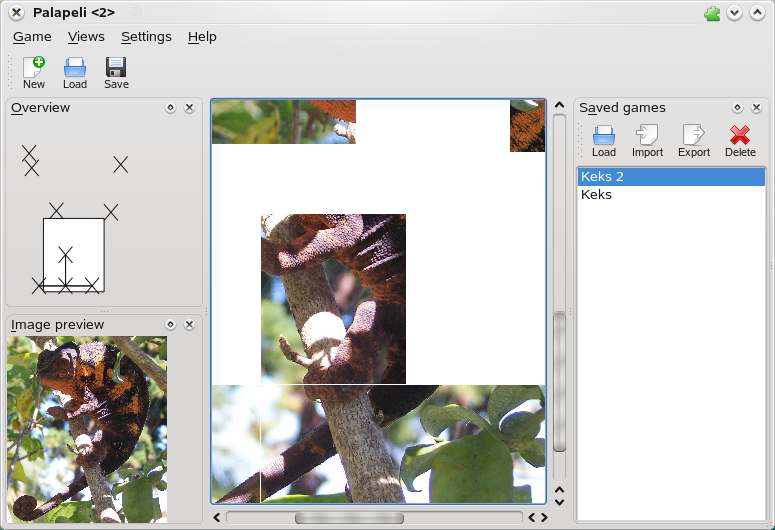
Currently, Palapeli offers a puzzle table where the pieces can be freely moved around. Pieces will snap together when brought together closely. For better overview, there is a minimap and an image preview available.
In the last weeks (as mentioned in one of the last Digests), I have been working on game management in Palapeli. This includes internal reference structures and (more interesting for the users) loading and saving of games. This is normally done in an internal storage, the interface is thus very simple. In the savegame management view, you can import and export games from the local storage into some kind of archive file which you can send over to your friends.
With Palapeli, your need to send a holiday card as a jigsaw puzzle is finally fulfilled.
That sounds wonderful, so what needs to be done?
Currently, all puzzle pieces are rectangular. Infrastructure for multiple pattern types is in place, so it should be easy to add traditional pieces (with such holes and plugs at the sides) or hexagonal pieces, or whatever. Also, to make Palapeli feel yet more natural, we are planning to implement rotatable pieces (Felix has confirmed to do this over the next few months). "Get Hot New Stuff" support would also be nice to have.
I'm looking forward to your suggestions and feature requests to make Palapeli the best jigsaw puzzle game!
|
|
I asked Kévin Ottens to explain some of the terms behind recent work on Plasma "web services":
|
SODEP is a small binary protocol used by the JOLIE project. During the Tokamak Mark I, we met the JOLIE developers and agreed to collaborate with them to fulfill our needs regarding web services in Plasma. Having a Qt based implementation of this protocol is the first stepping stone in order to use JOLIE within Plasma.
This implementation is already completely functional. The JOLIE developers did a good job of documenting their protocol, and in three hours I managed to get the Qt based implementation, covered by unit tests, and also passing the SODEP test suite. I'll probably rework a bit the API which is quite rough, and test the implementation a bit more.
We're targeting at having this as a private service within Plasma itself probably when KDE 4.2 hits the streets.
|
|
Simon St James re-introduces the KDE4Daily end-user testing service:
|
Things have gone a lot more smoothly this time with KDE4Daily - I made some scripts that log and itemise all of the dependencies I installed (I've been extra vigilant this time, and have nearly all optional dependencies for all of the provided modules - about 599MB worth!), and of course most of the work from last time is re-usable, although I've invested a fair amount of time in making it cleaner and more maintainable, so that future KDE4Daily's should be a snap!
Someone pointed out the trick of "flood-filling" an image with 0's to clean up any left-over debris from preparation, so in spite of the much larger array of dependencies, KDE4Daily 4.1 is only slightly larger than 4.0.
Still to come:- Improved (less resource-intensive) backtrace generation system
- investigation of native installation
- a mini-dashboard so people can easily see the latest revision and progress in preparing the next one (or any compiler errors that need fixing first)
- and, checking with the Plasma guys whether they want plasma-extragear rolled in!
Thanks go as always to everyone who has provided bandwidth (a reported 1700 HTTP downloads so far, courtesy of Tony and Kiyoshi!) and moral support!
|
|
|
| Statistics |
|
| Contents |
|
|
Bug Fixes |
Features |
Optimise |
Security |
Other |
|
Accessibility |
|
|
|
|
|
|
Development Tools |
|
|
|
|
|
|
Educational |
|
|
|
|
|
|
Graphics |
|
|
|
|
|
|
KDE-Base |
|
|
|
|
|
|
KDE-PIM |
|
|
|
|
|
|
Office |
|
|
|
|
|
|
Konqueror |
|
|
|
|
|
|
Multimedia |
|
|
|
|
|
|
Networking Tools |
|
|
|
|
|
|
User Interface |
|
|
|
|
|
|
Utilities |
|
|
|
|
|
|
Games |
|
|
|
|
|
|
Other |
|
|
|
|
|
|
There are 181 selections this week.
|
|
Bug Fixes |
|
Development Tools |
|
Vladimir Prus committed changes in /trunk/KDE/kdevplatform/shell:
|
Fix xmlgui crashes when closing views.
We failed to remove XMLGUIClient for Kate views when closing those views. As result KXMLGUIFactory used to hold on to deleted clients, and when we eventually created new view and tried to switch to it, "removing" old, already-deleted, one, things would crash. Or not crash, depending on luck, but usually, 10 attempts at opening/closing view were sufficient for segfault to appear. |
|
|
|
|
|
|
KDE-Base |
|
Peter Penz committed changes in /trunk/KDE/kdebase/apps/dolphin/src:
|
Fixed issue that sometimes the dragging from an inactive view to an active view does not work. Note that this is just a workaround, QAbstractItemView should take care about this itself.
I tried to provide a Qt-only example for this, but it is more tricky than I thought: it seems some expensive operations are required, so that the position of the second mouse-move event is outside the item area...
I'll retest this issue without workaround if Qt 4.4 final is out. |
|
|
|
|
|
|
|
|
|
|
Jakob Petsovits committed a change to /trunk/KDE/kdelibs/kdeui/widgets/ktabwidget.cpp:
|
If someone wants to properly factor the size calculation of the additional space for the close button from KTabWidget to KTabBar (where the close button is drawn), please do so by any means.
For now though, I just want tab icons + close button to autoshrink correctly in my Konqueror (only adding tab scroll arrows when they're actually needed), and this makes it work. |
|
|
|
|
|
|
|