|
Plasma support for Google Gadgets moves into kdebase. "Places" engine gets service support, and a new "Leave Message" Plasmoid for use with the Plasmoids-on-Screensaver project. More work on the "Weather" Plasmoid and "grouping taskbar", and an initial version of a menu applet for small form-factors, and a new applet to visualise the size of an IceCream compilation cluster. Work on the URL and breadcrumb navigator, and the "capacity bar" in Dolphin. A new "Sphere" effect in kwin-composite. More work on biased playlists, AFT, and a toolbox menu as a replacement for the applet browser in Amarok 2.0. A "fully working" Twitter plugin in Marble. Synonym and antonym modes working in Parley. More work on handling RAW images in Digikam. Various developments in KPilot, and keyboard shortcuts, colour scheme, and "export to HTML" work in the MessageListView project in KMail. Beginnings of master pages support in KWord. Initial import of KDisplay and kio_bookmarks. Kreative3d renamed to SolidKreator. Konversation 1.1 is tagged for release.
|
Xavier Vello introduces his entry into KDE development, kio_bookmarks:
|
A lot of my friends use bookmarks as a "read it later" repository, but not to easily access their favorite websites. With history-based URL-completion, typing an URL is faster than searching a bookmark in the browser's menu. If a bookmark is in a folder, it requires 3 mouse moves to activate, which is not that fast.
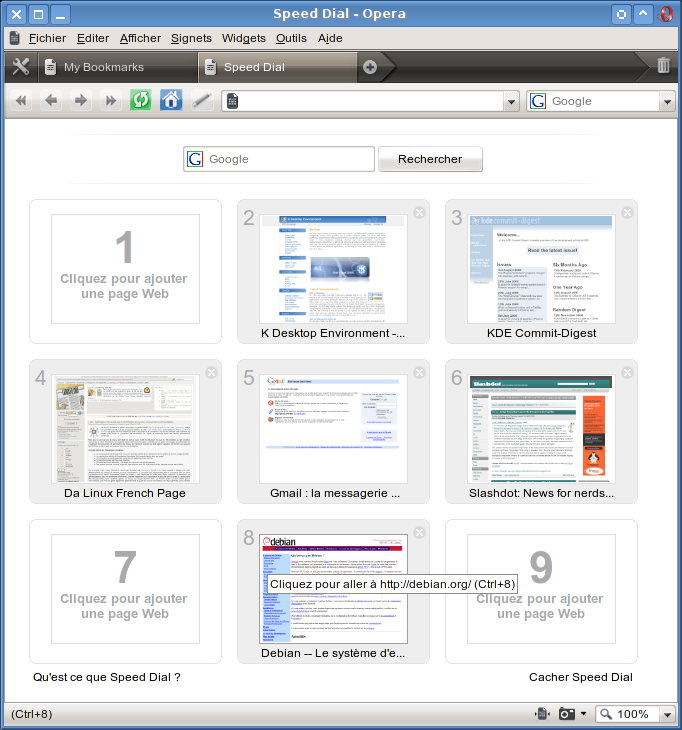
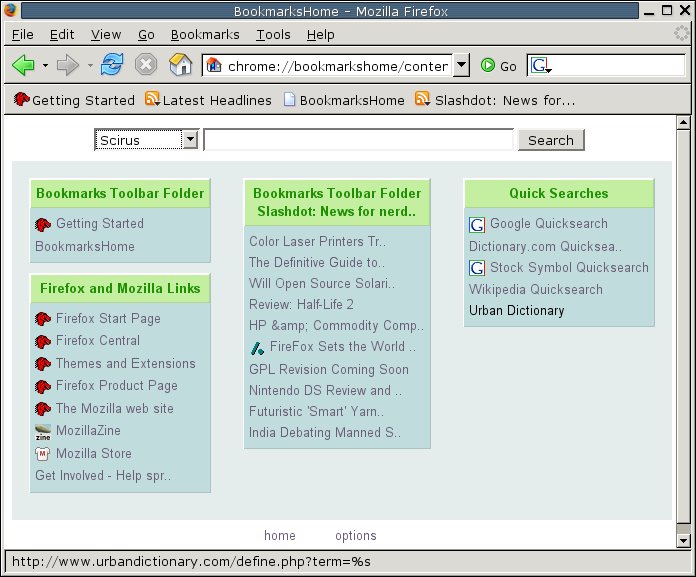
The new Opera "speed dial" feature (above left) reminded me of the "bookmarks home" Firefox extension (above right). This extension displays the user's bookmarks in a HTML page, allowing direct one-click access to them. Used as start page, it's a great way of accessing one's bookmarks rapidly.
I have used KDE since 1.1, and love the way KDE 4 is getting into shape. I took advantage of this new release to explore the underlying mechanisms and libraries, not as a user but as a developer, asking myself what I could do for KDE. Then, I decided to work on Konqueror's bookmarks handling. My first move is kio_bookmarks, which displays user bookmarks as a HTML page.
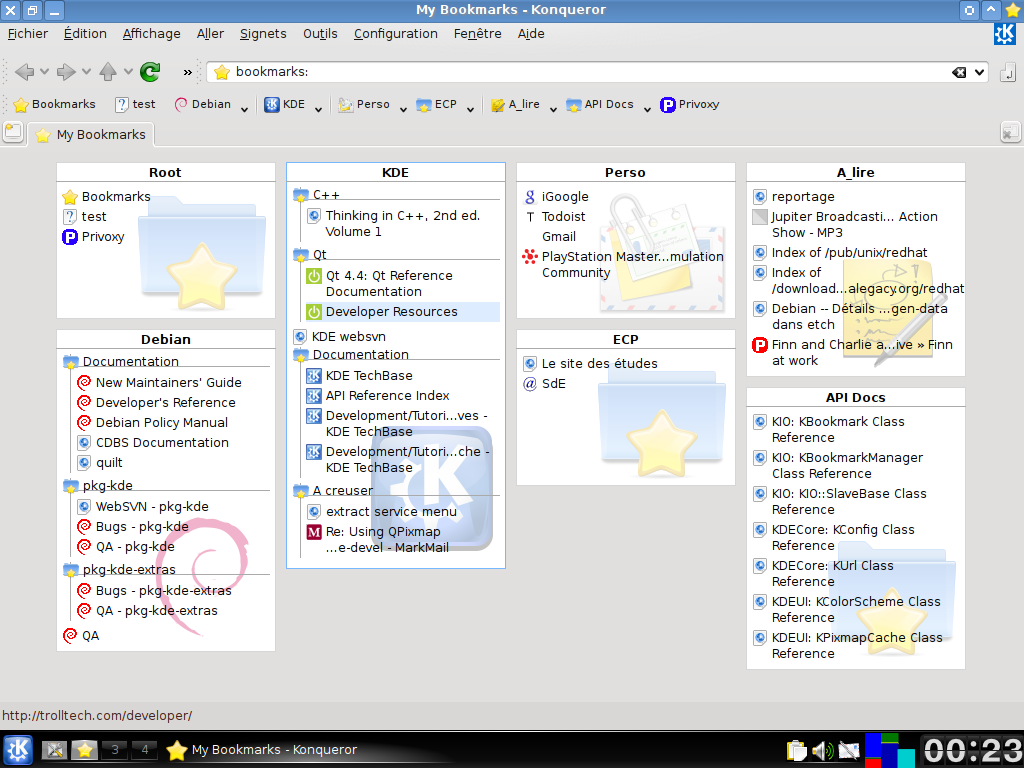
KIO slaves are a great technology: the kio_bookmarks process serves HTML and PNG content to Konqueror as a PHP script would do, and takes advantage of the KDE libraries and services. I think they are a good place to start digging into KDE, as long as one is aware of its restrictions. The one which drove me mad is that slaves can't receive D-Bus signals (bookmark changes, configuration updates, etc), so kio_bookmarks has to reparse everything each time the page is updated.
kio_bookmarks is available for KDE 4.1 on kde-apps and I hope to get it integrated in KDE 4.2. Ongoing features are a configuration dialog, web search form, and maybe other data sources ("places", and web history if technically possible). I also have plans for a Plasma applet and bookmarks editor improvements.
The great features to come in future KDE revisions seem to be Akonadi (a database-driven storage for PIM applications) and NEPOMUK (the "semantic desktop"). I think there's a way here to innovate in bookmarks handling (synchronization with online sources, tagging, scoring, and so on) and I hope to be part of it. One would say users hate to change habits (Epiphany got a lot of haters for its bookmarks tagging system), but isn't KDE4 about innovation?
|
|
Diego Iastrubni talks about the issues surrounding right-to-left language support across the KDE desktop:
|
I have been helping making KDE "speak" Hebrew for the last 5-6 years. My primary goal for the next half year is to make KDE4's Hebrew support as good as KDE3's Hebrew support, and then for KDE 4.3 making it even better.
I was not available for the development of KDE4, and thus I was not able to finish the translation of KDE 4.0, which led to KDE 4.0 being the first version of KDE to ship without Hebrew translation since KDE 1.1.4. Since version 3.0, KDE has also supported right-to-left (RTL) interfaces. To see how this looks, just run your favourite KDE application using "--reverse".
The Qt4 transition made a lot of mess in this area, and made some applications quite buggy, so I had to prioritise my attention to bug fixing: I need to compile applications (so I need Konsole!), so I asked Robert Knight to fix it, and i'd like to thank him for his wonderful fix.
I went on and helped him a little. Now that I can compile, my next goal was Kate, which I am still fighting. And then, Hamish Rodda started kicking in.
Now that I can code and compile, my text task was small tweaks inside Kate plugins... I noticed that the QListView which displays files in the file system browser is RTL, and (in my opinion) it should be left-to-right (LTR). Which led to a small patch inside kdelibs... and then on IRC I was informed about this bug, which was great, since it means fixing code in 6 different GUI related classes... great fun! I will fix the Dolphin display to be LTR, since this should be trivial.
In the pipeline, I have some other tasks:
- KLineEdit should display the icons depending on the content, and not layoutDirection(). To see this in action, enable "Ehnanced support for languages written right-to-left" inside QtConfig/interface, and then press control + shift on your keyboard to change the direction of the text.
- In Lokalize, I should fix this bug (well, port the functionality from KBabel and then fix the bug...)
- I need to add support to automatically detect the text direction inside KTextEdit so I can edit mails properly inside KMail, just like I do in KatePart.
- Add something similar to the rest of the display of emails inside KMail (this will affect all of KDE, more coding inside kdelibs...)
- Plasma needs a layout manager that knows about right-to-left issues.
- I still need to compile Amarok and see how can I help them guys, they do kick ass :)
- I am sure Digikam will have similar issues, and it's a great application. I would like to help them too...
|
|
|