|
New "Browser History", "Konqueror Sessions", "Konsole Sessions", and "Kate Sessions" KRunners in Plasma. Proof-of-concept of simple uploading in Plasmagik. A MythTV data engine for retrieving data about a MythTV installation (upcoming recordings, etc), and the start of a RSIBreak engine. An applet for displaying new message information from KMail, Kopete, etc for use with the Plasmoids-on-Screensaver project. Support for panel form factors, and a configuration dialog in the Lancelot alternative menu. Various improvements in the "Desktop Grid" KWin-Composite effect. More bugfixes for Kicker in KDE 3.5. A backtrace browser plugin for Kate. Code completion for PHP in KDevelop. More levels added in the Stepgame project. Lots of improvements in KGo, support for themes in Kapman. Window title tagged images in KSnapshot to assist indexing by Strigi. Support for reading form actions and removing annotations in Okular. Animated image support (eg. GIF) in Gwenview. First steps towards a Mailody Kontact part. More work for Amarok 2.0, especially regarding playlist handling. Start of a PDF import filter (for KOffice 2.1, using Poppler) in Karbon. Initial Kross integration in the Shaman package manager. More user interface work in KColorEdit. New device notifier moved into kdebase, new KsCD moved into kdemultimedia. Removal of viewer functionality in KPilot to become a syncing application only. Import of Kaffeine video player into extragear. Tagging of Amarok 1.4.10, a security fix release.
|
Cyrille Berger introduces "Darkroom", a new KDE application for batch processing RAW imagery:
|
Darkroom is a batch processor of RAW images, which are images produced by Digital Single Lens Reflex (DSLR) cameras, basically it's a dump of the internal memory of the sensor, in a sense it is the digital version of the film, while a JPEG/PNG image would be the digital version of the photographic print, hence the application name "Darkroom", since it was the name given to the room where silver films are transformed.
The target user profile of Darkroom is "William", a passionate digital photography amateur. William takes a lot of pictures, and since he wants to be sure he gets the maximum out of his pictures, he shoots photos as RAW. But William likes to share his passion with friends, or on the internet, or print them, and this means he needs to convert his RAW images to a file format that can be easilly seen and used by other people, Since William takes a lot of pictures, he needs to be efficient when doing the convertion, and have the possibility to easily handle a lot of images at the same time.
There aren't many applications in the Free Software world that enable this workflow: there are some GTK-based applications, there is a command-line tool, dcraw, which is used by Darkroom, Digikam, and Krita when decoding RAW images. But there was nothing that would integrate nicely in KDE. I see Digikam as good for managing my collection of pictures, and quickly do some light editing, while Gwenview is a fine light-weight image viewer - the KDE4 version is really good, but it seems unable to open RAW files at this time. Krita is specialized in high-end single image editing and creation. And now, Darkroom comes to complete the set of KDE tools for photographers.
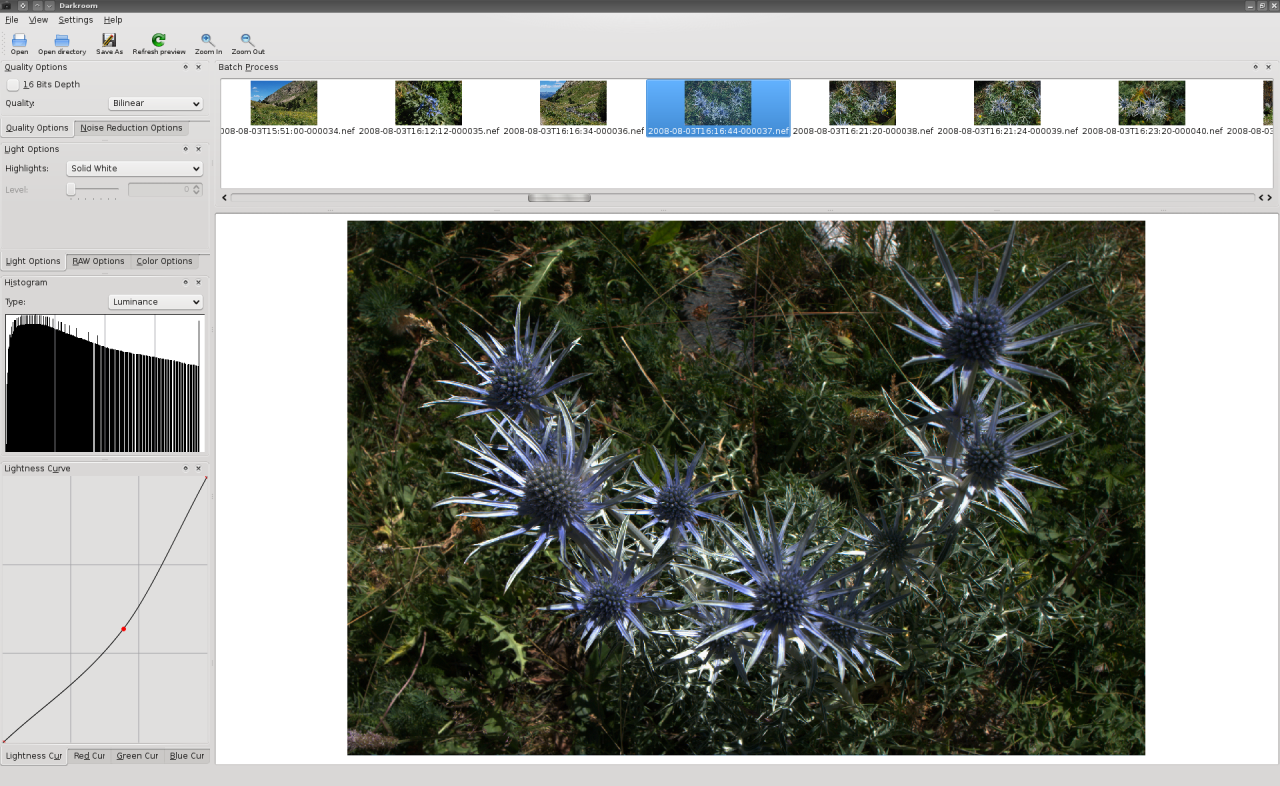
The goal for the future is to keep making William's life simpler and smoother, allowing him to work faster. There are many interface improvements that need to be implemented, for instance adding filtering support to the list of pictures, and so on. I am also wondering how KDE technologies can be used in Darkroom: though I don't want to see any collection management features in Darkroom, it could still be interesting to populate the list of images to process by using a NEPOMUK query, for example.
|
|
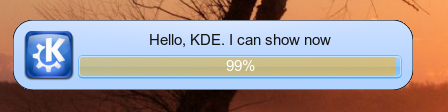
Ben Cooksley talks about his work on "KDisplay" (for On-Screen Displays in KDE applications):
|
KDisplay is a daemon that is designed to be used by applications that want to have an On-Screen Display (OSD) without the hassle of coding one. It also has an attached library named "kosdwidget", which means you don't have to use the daemon (which is actually for testing). This means that, for example, Amarok and KMix could have on-screen displays that have the same look and feel, which makes KDE applications seem more integrated.
When I finish, I hope to have a library and daemon that any KDE application could use to quickly display some information, such as the song currently playing, changes in volume/brightness, etc. The possibilities are actually quite endless... it has the ability to show an icon/image that is automatically scaled to fit, some text, and a progress bar (for the brightness/volume/battery people), and anything you don't use won't be shown either. KDisplay can also close when clicked, and close after a certain amount of time. It currently solves the problem where every application must have their own implementation, for example Amarok and K3b, which leads to consistency problems, and massive coding jobs for even the simplest OSD.
Currently, the framed rounded edge, progress, text and image display capabilities as well as the ability to close on time or on click, are complete. In the near future, I do not know where it will go: I could play videos/sounds, or integrate with KNotify to send events when a on-screen display hides or shows itself, but I am really out of ideas (any additional ones are welcome). Of course, I hope to move to a KDE module in the future!
The only technically difficult problems I have had actually relate to the positioning of the image and text, and figuring out how to get the rounded corners to actually work without giving X a hard time (i.e. 85-92% CPU usage with one OSD), but the OSD code from Amarok 1 was a big help.
|
|
|